Politics Was Never Designed for Mass Participation at This Velocity
One of the most widely recognized attempts to quantify human intelligence—however imperfect—is the IQ test.
While no serious scholar claims IQ captures the totality of intelligence, it does capture something real
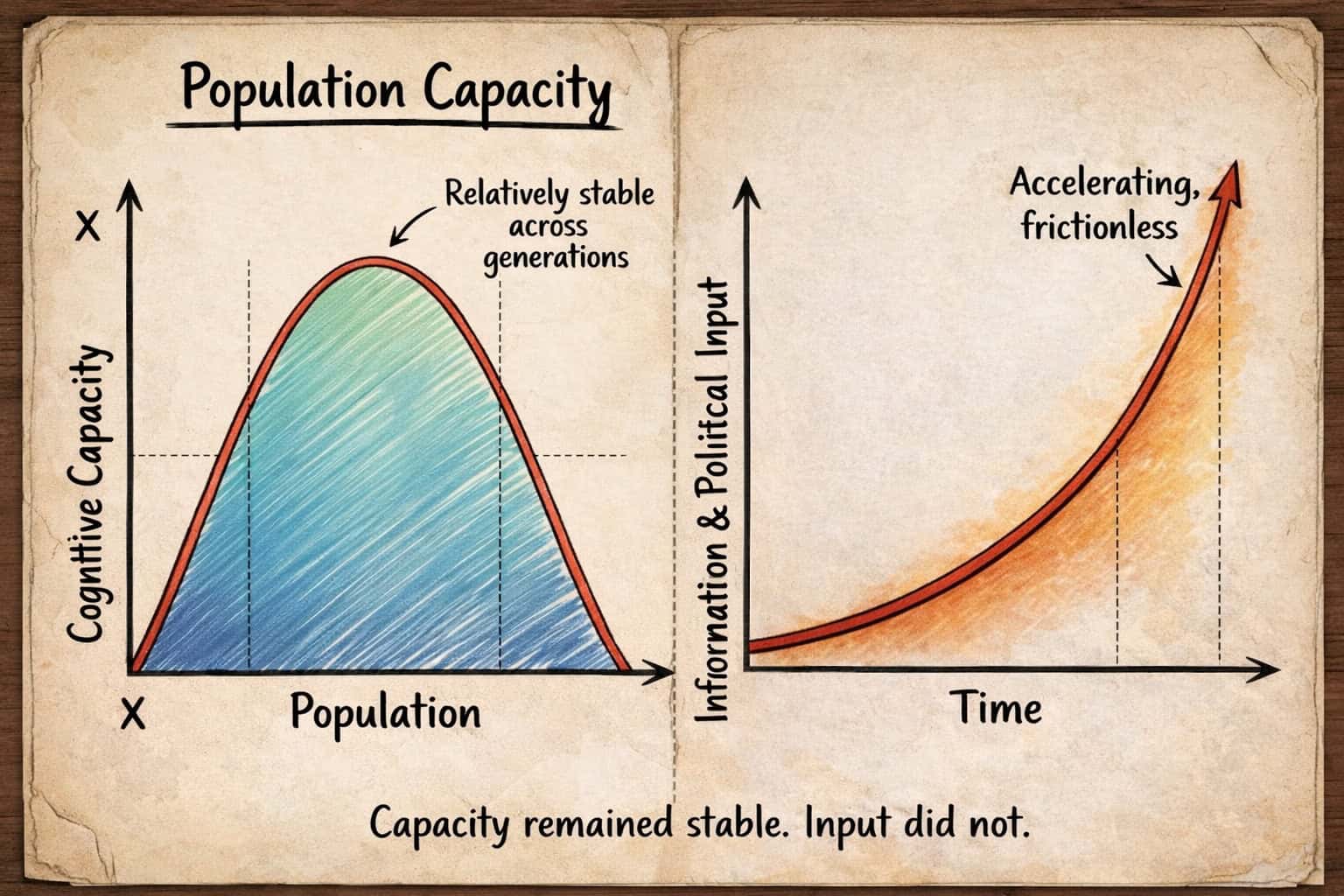
and stubbornly persistent: population-level cognitive distribution. The average IQ of large populations has remained
relatively stable over time. There has been no sudden, hidden leap in abstract reasoning capacity, systems thinking,
or impulse regulation across the general public.
What has changed—dramatically—is the surface area of political engagement.
Until very recently, political participation was constrained by friction:
- Time
- Literacy
- Social risk
- Effort
- Gatekeeping
These constraints acted as natural filters, not elitist ones. They didn’t ensure wisdom, but they did ensure that
sustained political engagement required patience, reading comprehension, emotional regulation, and a willingness to sit
with complexity.
Technology eliminated those filters almost overnight.
The modern individual now consumes political information at industrial scale, often packaged for speed, outrage, and
algorithmic reward rather than comprehension or truth. Crucially, this expansion of access was not matched by an expansion
in cognitive or moral capacity.
That mismatch is not neutral. It has consequences.
Information Access ≠ Cognitive Readiness
There is a common but deeply flawed assumption embedded in modern democratic optimism:
If people have more information, they will make better decisions.
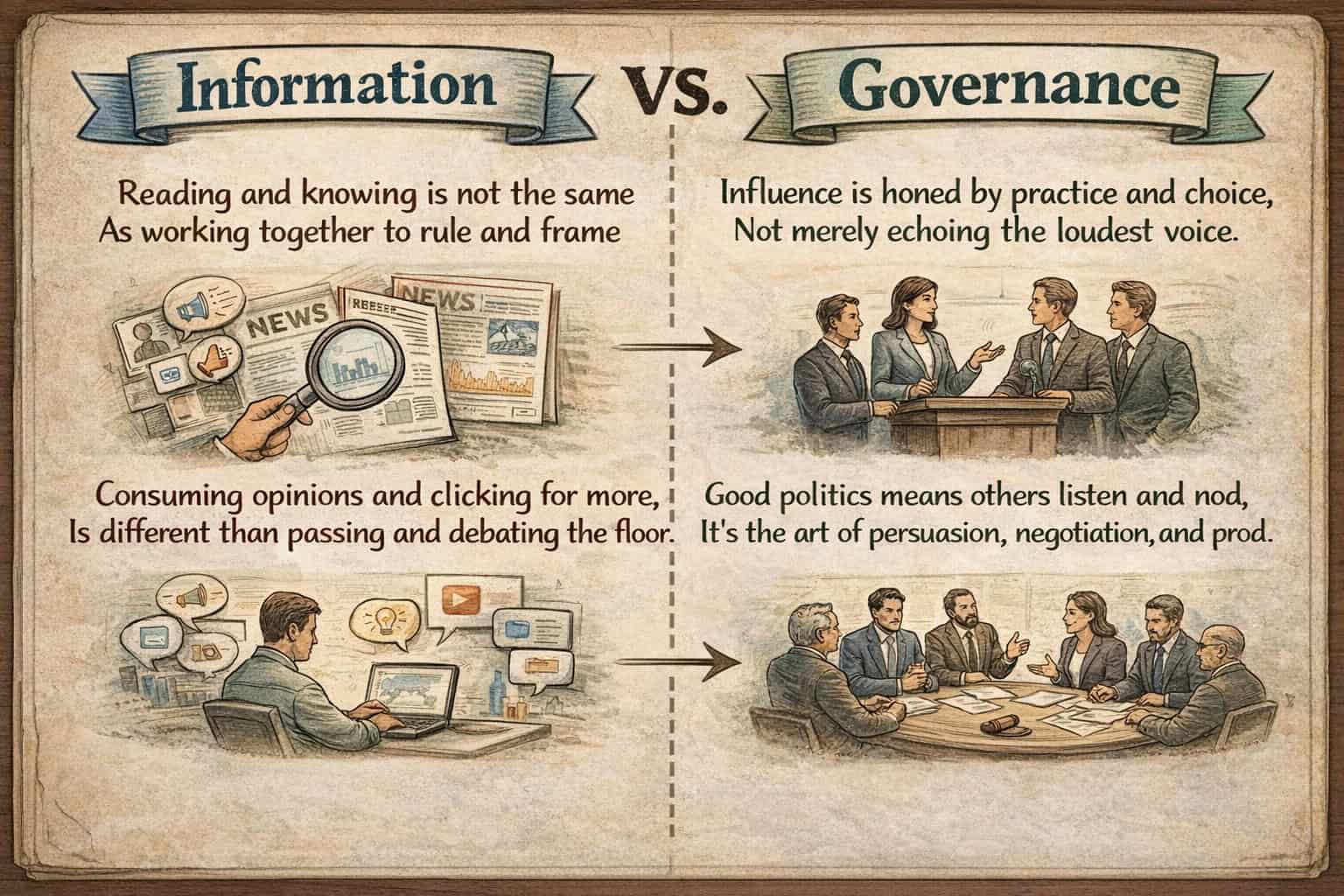
This assumption confuses availability with assimilation.
To understand a political issue—even a modest one—requires:
- Abstract reasoning
- Historical context
- Probabilistic thinking
- Empathy for unseen stakeholders
- Tolerance for ambiguity
- The ability to delay emotional payoff
These are not evenly distributed traits. They never have been.
When individuals who lack these capacities are suddenly thrust into high-stakes moral and political conversations, the result
is not “diverse perspectives.” The result is reactive cognition:
- Tribalism
- Moral absolutism
- Aggression disguised as conviction
- Performative certainty
This is not a moral indictment. It is a systems observation.
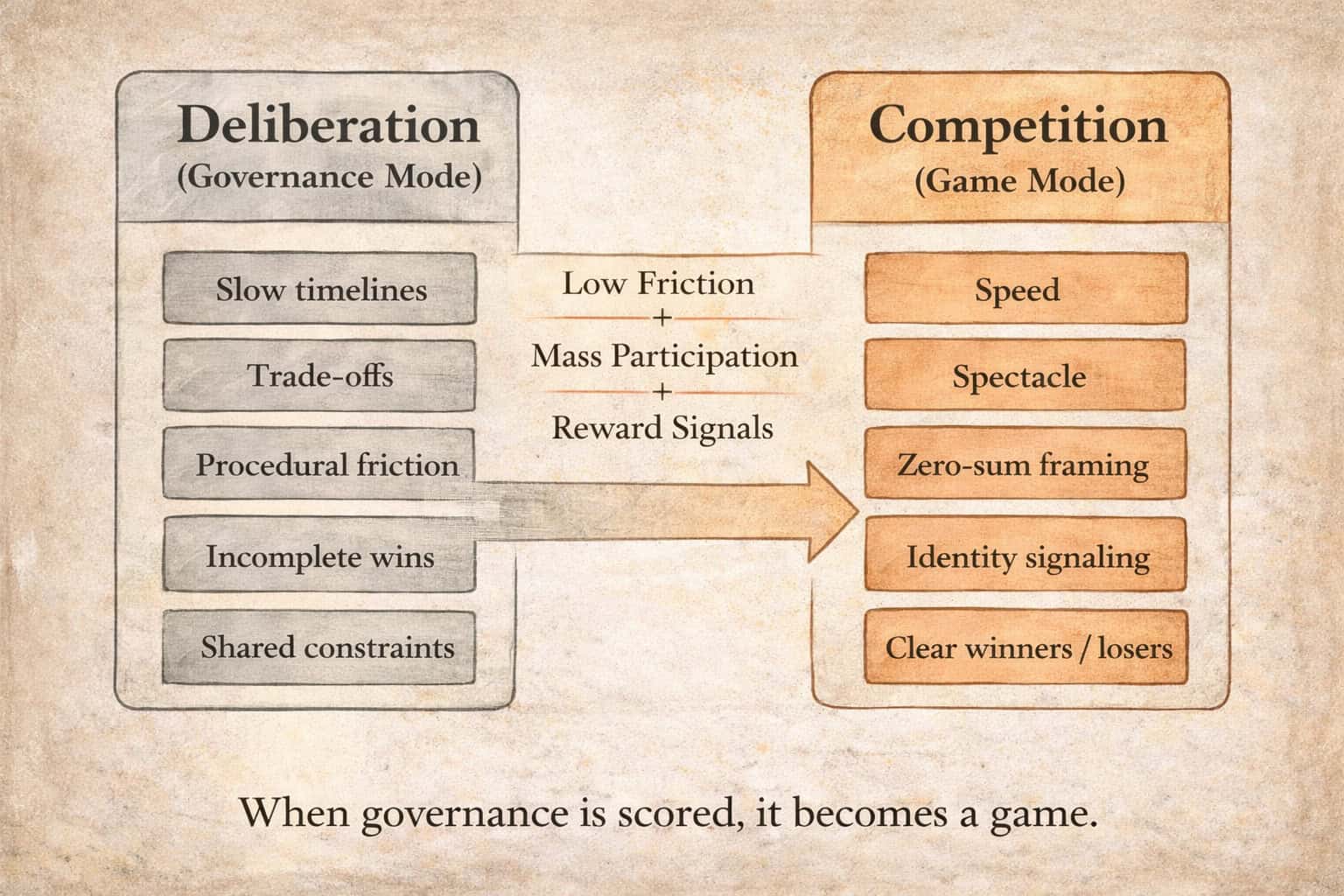
The Shift From Deliberation to Competition
Politics, at its core, is meant to be cooperative problem-solving under conditions of disagreement. It exists to answer questions like:
- How do we allocate limited resources?
- How do we protect the vulnerable without collapsing the productive?
- How do we update systems without tearing society apart?
None of these questions have “wins.”
Yet modern political discourse has been restructured—largely by low-friction platforms—into a competitive game. Points are scored
not by improving outcomes, but by:
- Humiliating opponents
- Signaling loyalty
- Dominating narratives
- “Owning” the other side
Once politics becomes a game, violence is no longer an aberration. It is a logical escalation.
Games have winners and losers. Politics does not—unless it has already failed.
Why Aggression Became the Default Tone
The rising hostility surrounding political conversation is often blamed on polarization, media bias, or bad actors. These are
secondary effects. The primary driver is simpler and more uncomfortable:
Large numbers of people are operating far beyond their cognitive and emotional competence, and the system rewards them for it.
When individuals lack the tools to argue abstractly, separate identity from ideas, accept partial solutions, or admit uncertainty,
they default to force—verbal, social, or eventually physical.
This mirrors a basic developmental pattern: when reason fails, coercion follows.
What we are witnessing is not heightened political passion—it is cognitive overload expressed as aggression.
Compassion Is Not Emotional Indulgence
Modern discourse often frames compassion as emotional affirmation. This is a category error.
True compassion is alignment with reality, not insulation from it. It involves:
- Honest assessment of capability
- Recognition of limits
- Protection of the whole from the dysfunction of the part
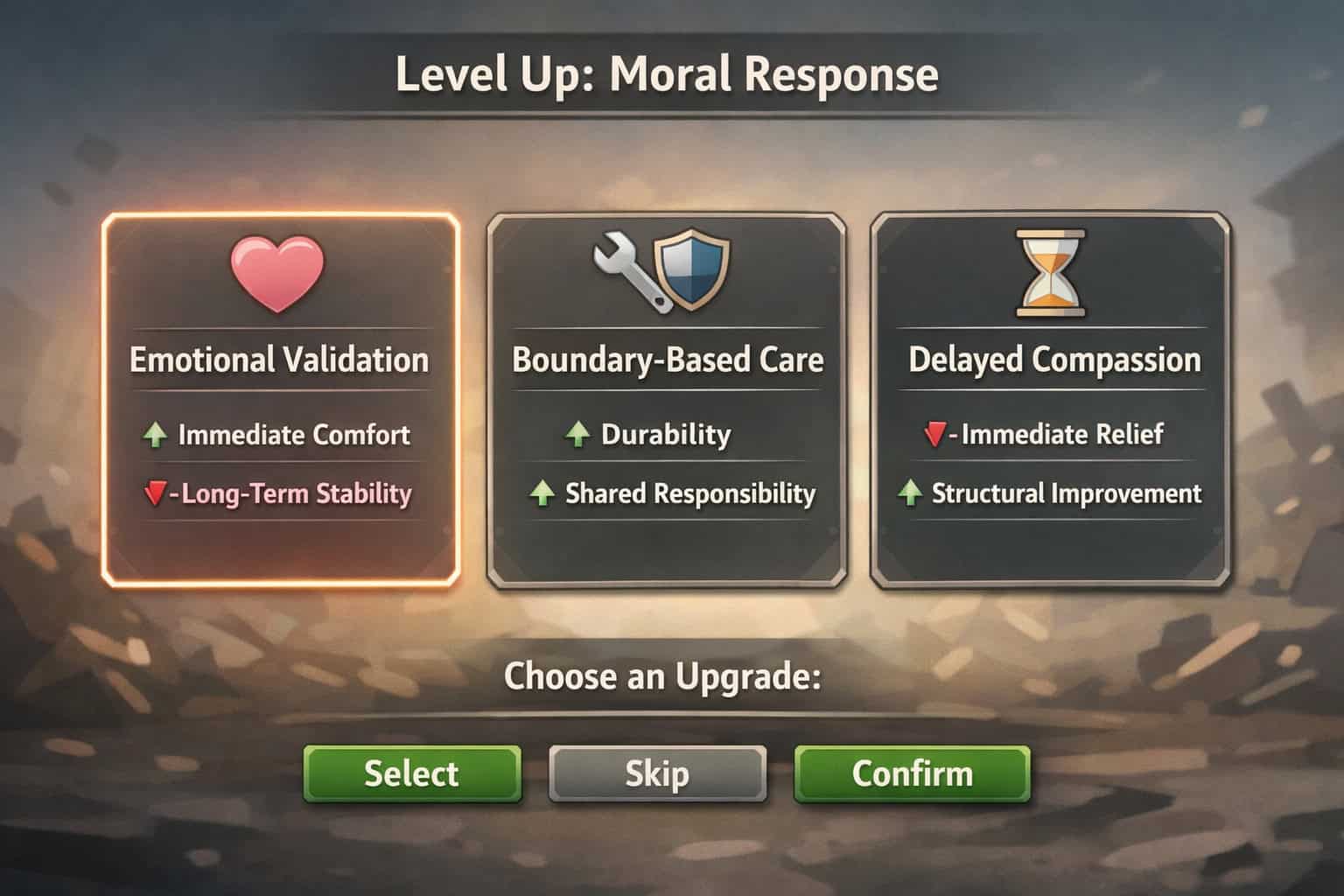
Allowing individuals to participate in systems they cannot meaningfully navigate is not compassion. It is negligence.
A society that refuses to acknowledge cognitive variance does not become more just—it becomes more chaotic. Indeed, and quite contrary to what you were likely taught unless you knew me growing up – some people are actually stupid. Differentiating degrees of such is where my helpfulness ended however since the answer obviously can’t be “Everybody!” Truthfully however, it’s nobodies job to figure this out because the places where it matters, individual personality differences will naturally filter and funnel people to where they belong, but! – only if we treat reality as it really is!
Why Politics Should Become “Boring” Again
Historically, stable societies shared a common trait: politics was important—but not entertaining.
It was procedural, slow, technical, and largely unglamorous. That boredom was not a flaw; it was a safeguard. It filtered out those
seeking stimulation rather than solutions.
If modern political engagement were stripped of instant feedback, performative outrage, social rewards, and identity validation,
many current participants would disengage—not because they were oppressed, but because they were never there to govern in the first place.
That disengagement would not be a loss. It would be a correction.
What Politics Is Capable of Being Again
Politics, properly understood, is:
- A mechanism for stewardship, not dominance
- A forum for trade-offs, not moral theater
- A discipline requiring restraint, not passion
It requires people willing to be wrong, to wait, to compromise, and to place long-term stability above short-term victory.
That kind of politics does not thrive in viral ecosystems. It thrives in quiet competence.
Final Observation
The current political climate is not a mystery. It is the predictable outcome of stable cognitive distributions, explosive information access,
and incentive structures that reward outrage over understanding.
Treating politics as a game does not merely cheapen it—it converts disagreement into conflict and conflict into justification for harm.
The solution is not better messaging. It is restoring friction, seriousness, and humility to a domain that was never meant to be entertaining
or universally participatory at speed.
That may not sound nice. But it sounds true.
You are a genius.